the Middle Ages
In Albert Camus's The Fall, the Middle Ages are not a chronological backdrop but a recurring moral and architectural reference point through which the narrator, Jean-Baptiste Clamence, articulates his vision of universal guilt and the inescapability of judgment. Clamence invokes medieval imagery to argue that the period possessed a brutal, honest clarity about human nature that the modern world has lost, replacing it with hypocrisy and hidden condemnation. The Middle Ages, in his telling, serve as a dark mirror held up to the present, revealing that the essential human predicament—being judged without a law, condemned without escape—has not changed, only become more insidious.
The Circles of Hell as a Spatial Metaphor
Clamence explicitly maps the geography of Amsterdam onto a medieval conception of damnation. He asks his listener, "Have you noticed that Amsterdam's concentric canals resemble the circles of hell? The middle-class hell, of course, peopled with bad dreams." This is not a casual simile but a deliberate spatial theology: as one moves inward through the canals, life and its crimes become "denser, darker," culminating in the last circle, where Clamence himself waits at the bar Mexico City. He declares, "the center of things is here, although we stand at the tip of the continent." The medieval hell, with its graduated circles of punishment, provides the template for understanding Amsterdam as a moral geography—a place where the newspaper readers and fornicators of modern Europe, having exhausted their capacity for evasion, finally stop and face the inner sea, chilled and lost. The city becomes a living diagram of Dante's Inferno, but stripped of its theological framework: there is no Beatrice, no ascent, only the endless fog and the gin.
The Little-Ease: The Architecture of Guilt
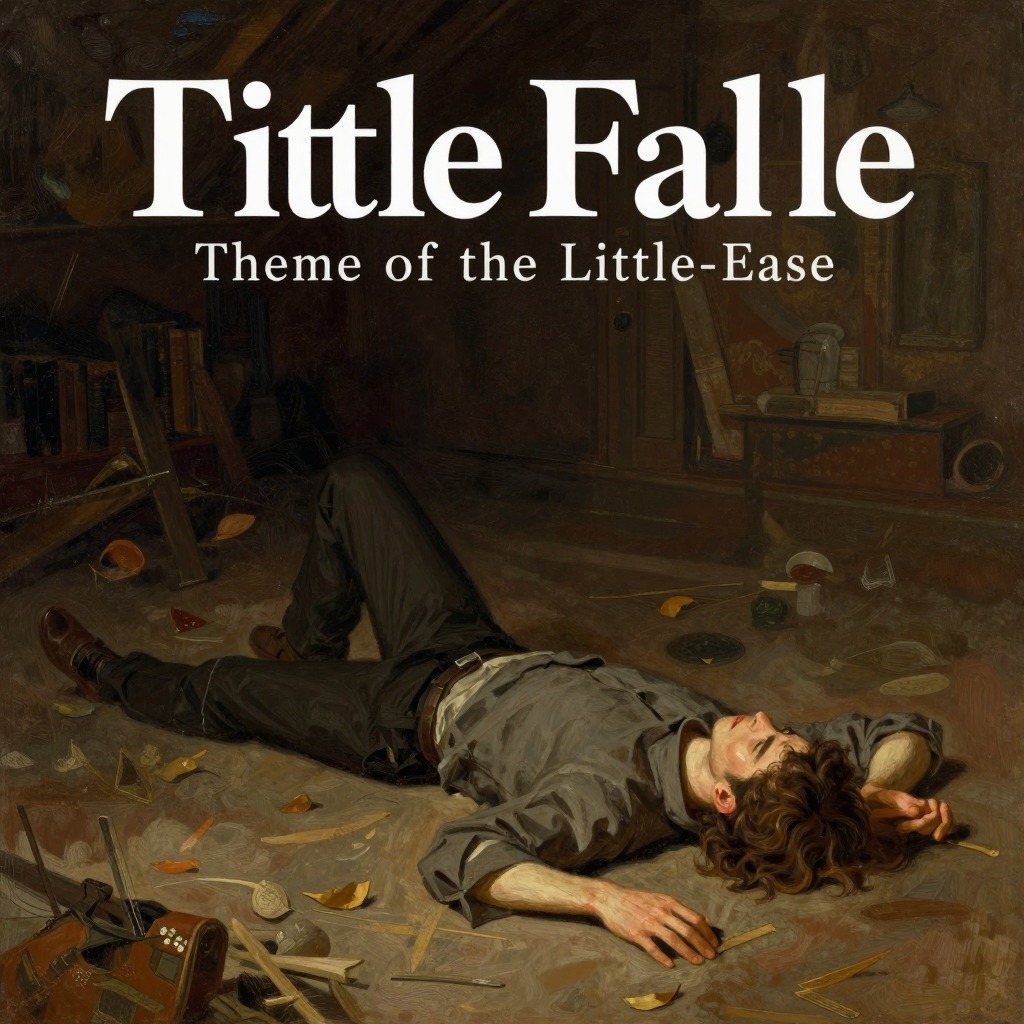
The most sustained medieval reference in Clamence's confession is the "little-ease" (in French, la bascule), a dungeon cell from the Middle Ages whose dimensions were ingeniously designed to prevent the prisoner from either standing upright or lying down. Clamence describes it with evident admiration: "That cell was distinguished from others by ingenious dimensions. It was not high enough to stand up in nor yet wide enough to lie down in. One had to take on an awkward manner and live on the diagonal; sleep was a collapse, and waking a squatting." For Clamence, this cell is a masterpiece of punitive architecture, a physical embodiment of the metaphysical condition of guilt. "Every day through the unchanging restriction that stiffened his body, the condemned man learned that he was guilty and that innocence consists in stretching joyously." The little-ease becomes the central image of Clamence's own spiritual state after his fall: a man who once lived on summits and upper decks, who "dominated the island" from the Pont des Arts, is now reduced to living on the diagonal, unable to stand or lie down, his body itself a confession of guilt. He explicitly rejects the possibility that innocence could survive in such a cell: "What? One could live in those cells and still be innocent? Improbable! Highly improbable!" The medieval invention, in his reading, proves the universal truth that "we cannot assert the innocence of anyone, whereas we can state with certainty the guilt of all."
The Spitting-Cell: Judgment Without God
Clamence extends his medieval architectural catalogue to include an even more horrifying invention: the spitting-cell, which he attributes to a modern nation but whose logic he traces back to the same medieval genius for punitive clarity. In this cell, the prisoner is walled up in a box that allows him to stand but not move, with a solid door that stops at chin level, leaving only his face exposed. Every passing jailer spits copiously on it; the prisoner cannot wipe his face, though he is allowed to close his eyes. Clamence presents this as a purely human invention, requiring no divine assistance: "Well, that, mon cher, is a human invention. They didn't need God for that little masterpiece." The spitting-cell represents the logical endpoint of a world in which judgment is immediate, physical, and unending—a world that the Middle Ages, in Clamence's view, understood better than the modern era with its pretense of humanitarianism. It is the antithesis of the "lofty places" Clamence once loved: the natural balcony, the mountain pass, the upper deck of a ship. The medieval cell, by contrast, is a space of absolute constriction, where the body is forced into a posture of perpetual humiliation.
The Medieval as a Contrast to Modern Hypocrisy
Clamence's medieval references serve to expose what he sees as the dishonesty of modern judgment. The Middle Ages, in his account, were at least honest about their mechanisms of punishment: the little-ease and the spitting-cell did not pretend to be anything other than what they were. Modern society, by contrast, has replaced these explicit instruments with a diffuse, invisible system of judgment that is all the more oppressive for being unacknowledged. Clamence contrasts the medieval slave dealer who openly advertised his trade—"You see, I'm a man of substance; I'm in the slave trade; I deal in black flesh"—with the modern equivalent who would never dare to display such a sign but practices the same domination under the guise of freedom. The medieval shop sign, shocking in its frankness, is preferable to the modern hypocrisy that hides slavery behind a smile. Clamence's own profession as a judge-penitent, which he practices in the bar Mexico City, is a deliberate inversion of the medieval confessional: instead of a priest absolving a penitent, Clamence accuses himself in order to earn the right to judge others, creating a "democracy of guilt" that mirrors the medieval understanding of universal sinfulness but without any possibility of grace.
The Medieval and the Modern: A Continuity of Guilt
Ultimately, Clamence uses the Middle Ages not to contrast a dark past with an enlightened present but to assert a fundamental continuity. The medieval inventions of the little-ease and the spitting-cell are not historical curiosities; they are the truth about human judgment that the modern world tries to forget. Clamence's own life, after his fall, becomes a version of the little-ease: he lives in a bare room in the Jewish Quarter of Amsterdam, on the site of one of the greatest crimes in history, his body wracked by fever and fatigue, his mind circling endlessly around the same confession. The medieval cell, in this reading, is not a relic but a prophecy. Clamence's final vision—of himself enthroned among his bad angels at the summit of the Dutch heaven, watching the multitude of the Last Judgment rise from the fogs and water—is a grotesque parody of a medieval Last Judgment painting, with himself as both judge and penitent, the only figure who knows the truth. The Middle Ages, in The Fall, are the name Clamence gives to the honest, unbearable truth that modern man spends his life trying to evade: that judgment is inescapable, that innocence is impossible, and that the only freedom lies in acknowledging one's own guilt and extending that acknowledgment to everyone else.